
Your first enterprise customer asks for a private deployment. The extra hosting bill is the small part of the answer. What changes is the operating model: who releases the software, who watches it, who may patch it, who answers an incident at 02:00 and who proves a restore works. Each is a recurring obligation for the length of the contract.
Short answer. Do not price the environment; price the retained operating work. Compare shared SaaS, single-tenant hosted by you and customer-managed deployment over the same contract term, and name who carries each line. Any line without an agreed owner is an unresolved deal cost: settle it before you sign, or take it into the price. This page gives no prices, because none can be quoted without your inputs; it shows variables and a labeled illustrative structure. It is for a founder or product lead who must choose: accept a dedicated environment, negotiate an alternative, or decline.
What exactly is the first enterprise customer asking you to host?
"Private deployment" can mean three different jobs:
- Shared SaaS (baseline): every customer uses your platform, with tenant boundaries enforced inside it.
- Single-tenant, hosted by you: a separate instance for this customer, in an account or site you control, run by your team.
- Customer-managed: you supply a release package; the customer runs it in their own cloud account or data center and controls the infrastructure.
Ask which requirement drives the request and whether the customer confirmed it in writing. If not, start with Your Product Works but the Enterprise Buyer Still Cannot Sign. Missing isolation evidence does not by itself justify a dedicated environment; Enterprise SaaS Readiness: Turn a Security Questionnaire Into Evidence covers that earlier decision.
The comparable unit is one named customer's obligations over one common contract term (T months), with the same product and acceptance rule in each column. Included: one-off work, hosting and tooling you pay for, recurring hours for release, patching, monitoring, backup evidence and incidents, the support window, exit. Excluded, listed separately: sales cost, roadmap work you would do anyway, legal fees, the customer's own costs. Unknown quote inputs: your loaded engineering rate, hosting bill, support cost, the customer's change-approval speed and the contract value.
Compare SaaS, single-tenant and customer-managed deployment
Cells name variables, not prices.
| Line over term T | Shared SaaS | Single-tenant, you host | Customer-managed |
|---|---|---|---|
| One-off work | Onboarding only (O0) | Separate stack, automation, configuration (O1) | Installable package, install guide, acceptance in their environment (O3) |
| Hosting and tooling | Shared; allocate a share (H0) | Dedicated stack, per month (H1) | Customer pays infrastructure; you pay for a test environment (H2) |
| Release and upgrade | Your normal release train | Effort per customer window (R1) | Packaging per release, plus support for versions not yet installed (R2) |
| Monitoring | Tenant-aware telemetry you run | A separate view of this stack (M1) | Only what the customer exports, possibly nothing (M2) |
| Patching | Yours, all tenants | Yours, inside their change window (P1) | Split; patch access is a contract item (P2) |
| Recovery evidence | One restore test | One test for this stack (B1) | Customer runs backups; you evidence the application restore (B2) |
| Incidents, support window | Standard cover | A committed window (S1) | Joint response; out-of-hours owner open (S2, S3) |
| Exit | Export, deletion | Decommission, show deletion (X1) | Customer holds data and installation; license use afterwards needs a clause (X2) |
| Commercial terms | Standard | Premium or fee for dedicated service (D) | License and support fee, customer prerequisites (D) |
Map release, observability, data and support ownership
Mark where responsibility changes hands from release to upgrade.
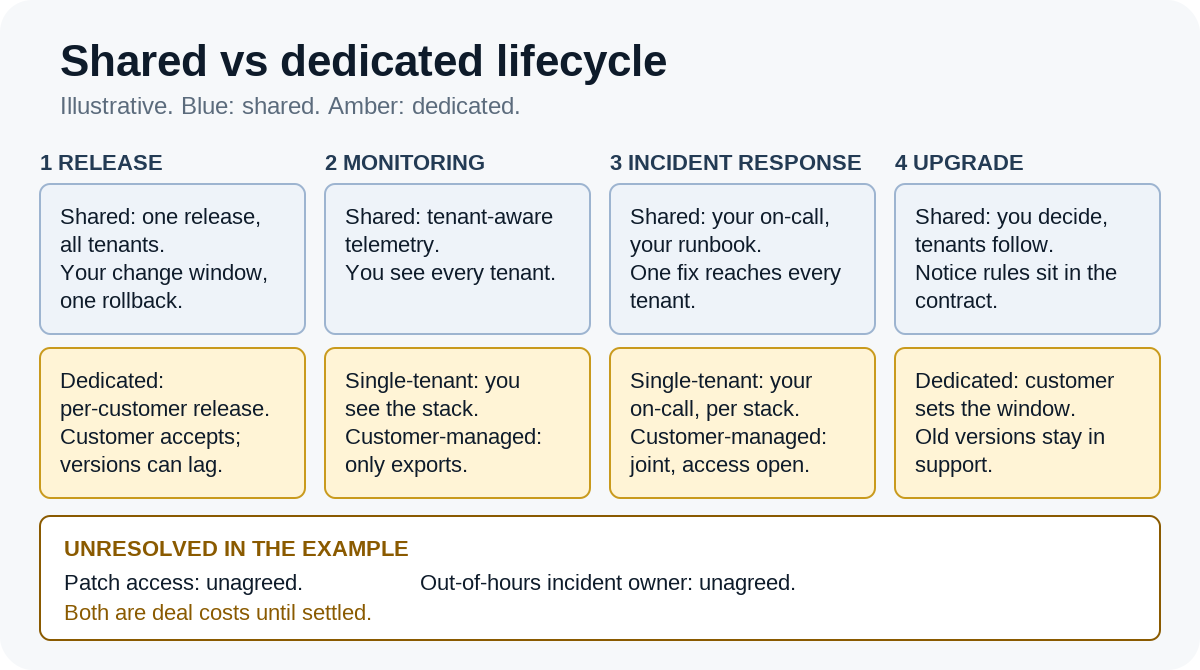
A filled example: customer-managed deployment
Illustrative: an invented customer, no result.
| Duty | Customer | You | Status |
|---|---|---|---|
| Infrastructure access | Owns it | Requests it per task | Agreed |
| Backup execution | Runs the backups | Documents the restore procedure | Agreed |
| Application release package | Installs it | Builds and tests it | Agreed |
| Release acceptance | Accepts each release | Accepts each release | Agreed, both |
| Patch access | Whether you may touch the host is open | Open | Unagreed |
| Out-of-hours incident ownership | Who answers is open | Who answers is open | Unagreed |
Record the two unagreed rows as unresolved deal costs: work you may inherit unpaid. Negotiate them before accepting the private-deployment obligation; otherwise your price may cover less than the support the customer expects.
What on-premises experience adds, and what it does not. Gabriel Wainmann's profile describes a private AI practice (LambdaTwo, since 2024) building clinical AI that runs entirely on-premises inside hospitals, a clinical-documentation program designed to be air-gapped, and an edge handover system for ambulance crews with automatic de-identification and FHIR export. These are career statements, not a Grand Rounds engagement, a deal or a result; the profile lists Grand Rounds availability as "Coming soon". Our inference, not the profile's: when software runs inside the customer's environment, the vendor sees less of it, so access, data handling and update paths need to be agreed rather than assumed. Deployment isolation is not automatic clinical approval, data permission or regulatory compliance; each needs its own evidence and owner.
Four ownership questions for any model. Release: who builds, who installs, who accepts? Observability: what can you see without asking permission? Data: where does it sit, who may copy it, who deletes it? Support: who answers, with what access, and in which hours?
AWS's page on multi-tenant building blocks for software vendors, read on 18 November 2026 (it shows no publication date, only a 2026 copyright notice), describes a "silo" model with dedicated infrastructure per tenant as having the strongest isolation and highest operational overhead, and a "pool" model as lowest cost. It adds that without tenant-aware telemetry, isolated customer issues can appear as platform-wide outages, and describes switching off a bad release for a single tenant. It is an infrastructure vendor's view for vendors hosting in its cloud; we found no treatment of customer-managed operation or contract responsibilities, which is why the table above adds them. Source: AWS, building blocks of multi-tenant SaaS architecture.
Test updates, incidents and exit under the proposed model
A table of owners looks complete until a failure tests it. Walk each scenario through the proposed model and ask for the record that proves the answer.
| Scenario | Question | Evidence to hold | Owner to name |
|---|---|---|---|
| Urgent security patch | Who can apply it here, and how soon does the contract require it? | Patch procedure, access list, customer's change route | Engineering lead, customer IT |
| Release n ships | Who accepts it? What happens to a customer on release n−1? | Supported-versions rule, acceptance record | Product owner |
| Failure at 02:00 | Who is paged, who has access, who may restart or roll back? | Escalation path, access method | Support lead, customer operations |
| Restore | Who ran the last restore test, where, with what record? | Dated test record | Engineering lead; customer for backups |
| Exit | Who deletes data and confirms it? How long is the last version supported? | Exit clause, deletion confirmation | Founder, customer sponsor |
An answer of "it depends" usually points to a missing contract line rather than a technical detail.
Agree the client and supplier responsibilities before signing
Turn the ownership table into a schedule attached to the contract; counsel on both sides decide the wording. The schedule should settle:
- Release cadence, who accepts a release, and which versions you support and until when.
- Who holds access, by what method, with what record of use, and whether you may patch.
- Support hours, severity definitions and response commitments, including out-of-hours. The figures are for you and the customer to agree; this page supplies none.
- Backup execution, restore testing and who produces the evidence.
- What telemetry leaves the customer's environment and who may read it.
- Customer prerequisites, and what happens to your commitments if they are not met.
- Pricing for work outside the schedule.
- Exit: data return and deletion, remaining license rights, last-version support.
Then choose a path. These conditions are examples, not rules for every product.
| Path | When the evidence points to it |
|---|---|
| Accept | Every line has a named owner, the retained cost fits inside the contract value, and the team can run a second environment without starving the shared one. |
| Negotiate an alternative | The requirement is real but a narrower response could meet it: shared SaaS with stronger boundary evidence, single-tenant hosted by you with a defined support window, or a staged pilot first. |
| Decline | The customer will not settle access, patching or incident ownership, or the retained work is larger than the contract can carry. |
For an outside view, How to Choose a CTO for an Enterprise Readiness Milestone describes defining the mandate first and keeping assessment, milestone leadership and implementation separate. Technology Assessment & Architecture Review describes a bounded review against one business decision, with a proposed written decision memo that separates inspected evidence, assertions and unknowns. Your sponsor decides; leading or implementing the work is a separate mandate, and the page says timing and commercial terms follow a fit-gap review. Fractional CTO Services: What a Part-Time CTO Covers and When It Fits says on-call incident ownership and implementation are not included by default. Ask who will answer the out-of-hours call before assuming a senior hire covers it.
Price the retained operating work against the contract value
Build the number last, from the ownership table. For one customer over term T:
Retained cost = one-off work + hosting and tooling × T + recurring engineering and support hours × loaded rate × T + exit work + a line for every unresolved duty.
Compare it with the contract value over the same term, after any discount or premium (D). If the same engineers are taken off the shared product, that opportunity cost belongs in the comparison.
The arithmetic below uses placeholder units only. They are not prices, benchmarks or a customer result. Suppose the contract is worth 100 units over 24 months. One-off work is 15 units. Recurring cost (hosting, release, monitoring, patching, support) is 2.5 units a month, so 2.5 × 24 = 60. Retained cost is 75, leaving 25 units before anything unresolved. Now suppose unagreed out-of-hours cover would cost a placeholder 0.5 units a month: over 24 months that is 12 units, and about half of the remaining 25 is gone. A second unagreed item could remove the rest. Until the unagreed lines have prices or owners, the deal is neither worth it nor not worth it.
Two checks keep this honest. Finance accepts the figures and the engineering lead accepts the hours. A guess and an unknown are different things, so label each.
Boundaries
All numbers on this page are placeholders or variables. This is not legal, accounting or pricing advice. A dedicated environment does not by itself give a customer clinical approval, data permission or regulatory compliance. Grand Rounds is an initiative of Dinarys, and a conversation may lead to cooperation with Dinarys.
Next step
Take the one customer request on your desk and fill the duty table above for it, with a name beside every row. Mark each line that is not yet agreed as an unresolved deal cost, add a variable or placeholder price, and take the list back to the customer before you accept the private-deployment obligation. If the lines will not close, or you cannot tell who should own them, bring the customer's stated requirement, the table and your deadline to the assessment or CTO routes above and ask whether a bounded review fits. Any engagement is separately scoped.